

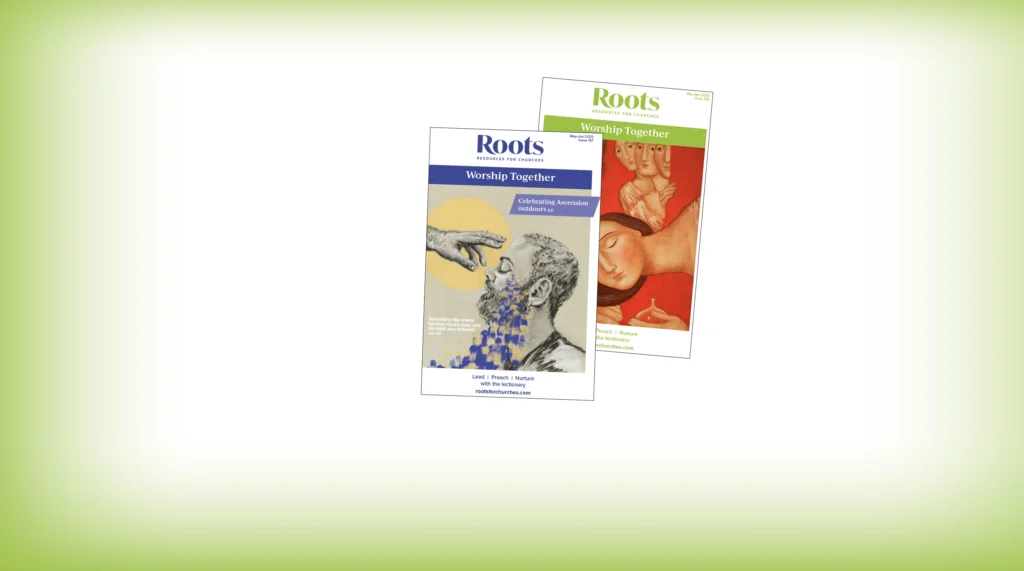
Roots for Churches is an ecumenical partnership (The Methodist Church, Church of England, The United Reformed Church, Sunday School Board of Wales, Christian Education, and Churches Together in Britain and Ireland) founded in 2002 to publish resources for churches that are following the Revised Common Lectionary and Common Worship. Roots serves 8000+ churches with print and digital resources for weekly and seasonal worship, preaching, small group Bible study, outreach, and faith formation.
New research from The Institute for Children, Youth & Mission (CYM) and Liverpool Hope University has found that young people who already attend church have an overwhelming desire to be more involved in Sunday services.1 However, in the same report, church leaders revealed a distinct lack of confidence when it comes to including and engaging young people in services.2
Is ‘getting the young people involved’ yet another thing to add to church leaders’ to-do lists? And, if they do, wouldn’t this alienate older church members who already seem to avoid church on the weeks when an ‘all-age service’ is scheduled?
How is it possible to make this desire for greater involvement good news, rather than just another item on an already overwhelming tick-list?
‘This is where an intergenerational approach to ministry comes into its own,’ says Melanie Cave, Managing Director of Roots for Churches. ‘Intergenerational ministry is about intentionally gathering people of different generations to learn, worship, serve and share life together. It’s not all-age by a different name, and it’s not just for children,’ she explains. ‘It’s for everyone – a place to be known, contribute, share and explore. The different component parts of the service are shorter and less wordy, but it’s also multi-sensory, so it’s a more engaging way to do church. That makes it helpful for those with dementia, ADHD, dyslexia, neurodiversity, English as a second language, different learning styles – all of us, really.’
This drive to equip churches in this way has led Roots to rename some of its resources. For the past sixteen years, Roots’ lectionary-based resource for leading services have been called Adult & All Age. But, from Jan-Feb 2025, ‘Adult & All Age’ is no more. This resource is now called Worship Together.
Worship Together implies a unity of purpose that the dual silos of ‘Adult’ and ‘All Age’ could never achieve. ‘Even if your church doesn’t have any children or young people, it’s still going to be intergenerational,’ explains Tracey Messenger, Editor of Worship Together. ‘Someone who is 40 is obviously of a different generation to someone who’s 70: they’ll have different life experiences, different cultural references, different ways in which they like to worship. Intergenerational worship makes the most of the gifts of everybody.’
In valuing and including people’s contributions regardless of age, these resources can support church leaders who lack confidence in getting alongside young people. ‘In making space for people of all generations to relate to each other, the bonds between young people and older role models will get stronger and stronger. And it’s not all one-way: young people can also act as role models to their elders,’ Melanie explains.
This desire to build relationships and learn from role models is a key motivator for young people. In Taking the Pulse of Children’s Ministry focus groups, young people stated that they could look up facts about religion online, as if they were doing RE homework. But on matters of belief, they expressed a desire to talk to someone they trust.
Roots’ Worship Together resources have long been structured in a way that facilitates intergenerational worship; differentiating worship activities by spiritual styles rather than by ‘age appropriateness’.3 Yet for church to be truly intergenerational, there has to be intentionality. With that in mind Roots is launching a year-long series of articles from January, encouraging churches to grapple with the theology and theory as well as the practicalities of intergenerational ministry.
‘We hope to equip church leaders to explore and live out the values of intergenerational worship: young, old and everyone in between, with our diverse needs and gifts, worshipping, learning, leading and serving together,’ says Melanie. ‘That’s a vision and experience of church we can all enjoy and get excited about. One I think God is committed to as well!’ Involvement, engagement and welcome for everyone? Now that’s good news.
Notes for Editors
Roots separates content broadly into two sections:
- Worship Together: for preaching and intergenerational worship, including weekly lectionary-based Bible notes, preaching materials, including a full sermon, hymn and song suggestions, a full intergenerational outline for worship, prayers, intercessions, a Bible Study on the lectionary passages, a topical Bible Study for those exploring faith, faith at home resources, and seasonal resources and outreach resources (such as a nativity trail or harvest festival)
- Children & Youth: Weekly lectionary-based sessions for Children, Youth and Under 5s, song recommendations, a children’s Bible story retelling, a full-page illustration, colouring sheets, activity sheets, crafts, games, prayers, and seasonal content, outreach resources (such as a Light Party or Holiday Club) and topical small group outlines.
Roots publishes two print magazines (with a curated selection of content), with all content also available as digital subscription at rootsforchurches.com. Roots subscribers are primarily in the UK and Ireland, but also stretch across Australasia, North America, Europe, and Africa.
1 In the new report, Taking the Pulse of Ministry Amongst Children, Youth and Families, Dr Sarah Holmes says: ‘The young people expressed very clearly that they want to be involved, visible and valued in church.’ But, she warns, to do this in an authentic, not tokenistic way requires buy-in from everyone in the church. See: Taking_the_Pulse_of_Ministry_Research_Report_Final_Draft.pdf page 4.
2 In Taking the Pulse of Ministry Amongst Children, Youth and Families, church leaders were asked what resources they most needed. A key expressed need was guidance on building relationships with children and young people, and supporting their mental health. See: Taking_the_Pulse_of_Ministry_Research_Report_Final_Draft.pdf page 31 (diagram)
3 In books and articles, notably Educating Faith and Conversations that Change Us, Joyce Bellous identified four pathways of spiritual expression, known as spiritual preferences or styles: Word, Emotion, Symbol and Action. David Csinos relied on these styles in his research into children’s spirituality and religious expression in his book Children’s ministry that fits: beyond one-size-fits-all approaches to nurturing children’s spirituality. They proclaim that difference is healthy, natural, valuable and creative. Find out how Roots helps church leaders cater for different styles: rootsforchurches.com/spiritualstyles
Find out about the latest initiatives from The Synergy Network and its work to help end Violence Affecting Young People in Britain and Ireland.

Discover the key messages from the conference “Are We Ready? Co-creating a response to the quiet revival”.

Watch again: Join the Synergy Network for an inspiring conversation with colleagues from Kingston, Jamaica, as they share their work with young people.

Synergy Network's ‘One Pledge, One Change’ campaign aims to reduce or eradicate violence against young people.